
Conditions
What Migraine Really Is
Far more than head pain — migraine is a disorder of nervous system regulation that touches nearly every part of how you feel and function.
Understanding Migraine Disease
Migraine: A Modern Neurophysiologic Definition
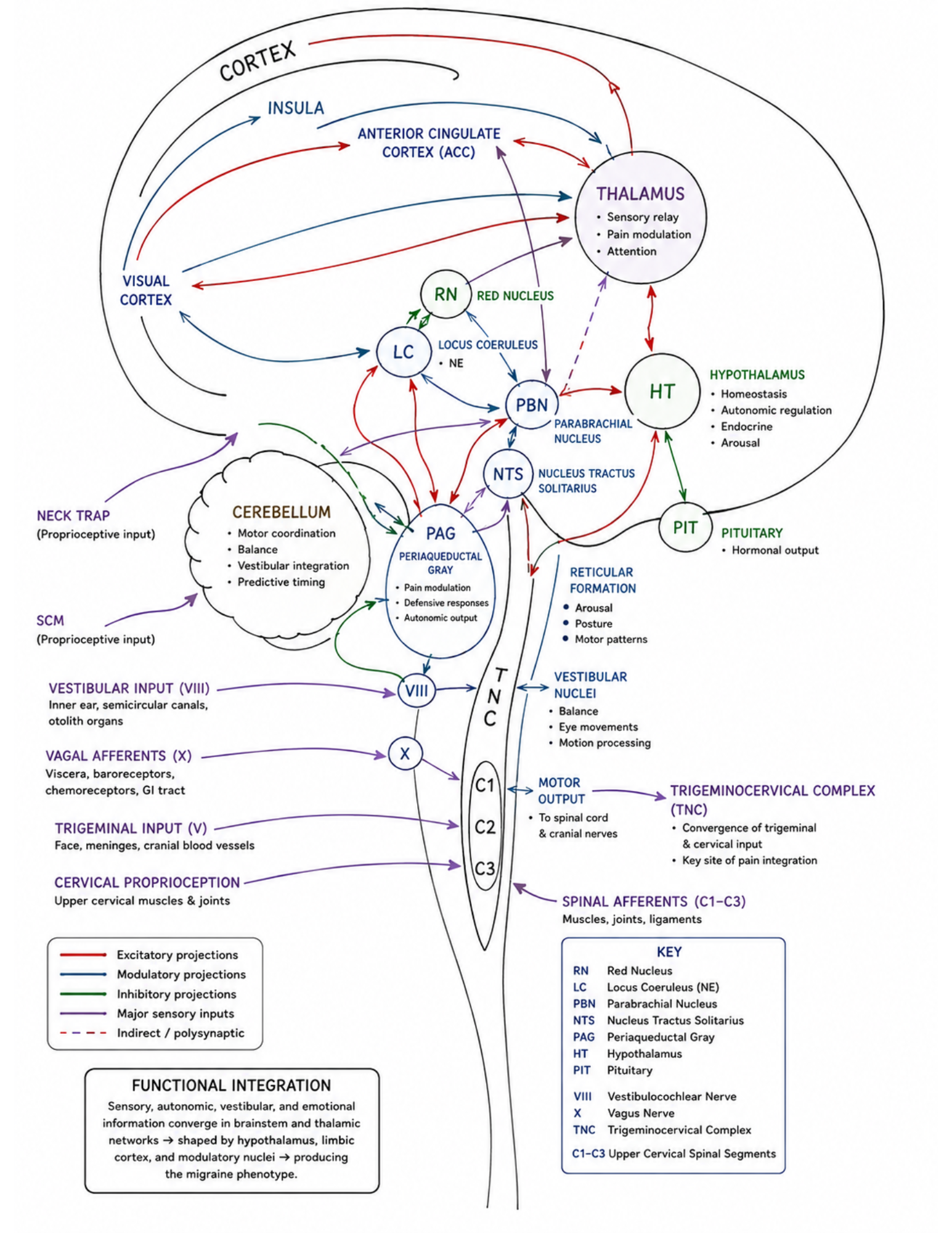
Migraine is a disorder of nervous system regulation characterized by episodic or persistent dysfunction of distributed brain networks responsible for sensory processing, autonomic regulation, cognition, emotion, and pain modulation. Rather than representing a disease of headache alone, migraine reflects an inherited predisposition toward altered neuronal excitability and impaired regulation within interconnected cortical, hypothalamic, thalamic, brainstem, and trigeminovascular circuits. These networks continually integrate internal physiologic state with external sensory information, and when regulatory thresholds are exceeded, they generate the characteristic clinical symptoms of migraine.
Translation: Migraine is a problem with the nervous system's ability to control external information's effect on the system resulting in migraine symptoms. A rough translation but fair.
The neurobiology of migraine is a complex system mediated by the interaction of multiple neurotransmitter and neuromodulatory systems rather than a single chemical pathway. The major central regulators of migraine are serotonin, norepinephrine and histamine affecting sensory sensitivity, vigilance, and brainstem function. Downstream or peripheral players are inflammatory mediators, calcitonin gene-related peptide (CGRP) and numerous additional signaling molecules that interact dynamically to influence neuronal excitability, cortical processing, trigeminovascular activation, neurogenic inflammation, and central sensitization.
Clinically, we broadly yet effectively divide migraine into the categories of episodic and chronic migraine. The episodic variant produces recurrent episodes of reversible activity that are representative of a nervous system that is able to achieve long term stability such that groupings of the symptoms that represent migraine a.k.a. NS irritability, strictly speaking only occurs 2-3x/year. The chronic presentation is characterized by a variably fluctuating neurological dysfunction that is clearly represented by 2+ migrainous symptoms greater than 10 days/month. There is not a consensus position on this definition, however, this reflects state of the art.
Symptoms are far reaching and may include light/sound/smell sensitivity, nausea/vomiting, dizziness, neck tension/pain, fatigue, brain fog, anxiety, visual disturbances, sensory symptoms, language impairment, the very large category of autonomic problems and headache. Migraine is therefore best understood as a disorder of abnormal neural network regulation whose defining feature is transient impairment of normal brain function across multiple sensory, autonomic, cognitive, emotional, and pain-processing domains.
Finally, the field of migraine science has been trying to dissociate itself from migraine being a primary trigeminovascular disorder, or headache centric problem. It is more accurate to describe it as a systems-based CNS disorder or brain network disorder. In that framework:
- Hypothalamus sets the physiologic state (sleep, hunger, circadian rhythm, stress).
- Brainstem nuclei (especially the dorsal raphe, locus coeruleus, periaqueductal gray, nucleus tractus solitarius, and parabrachial nucleus) regulate vigilance, autonomic tone, and descending pain control.
- Thalamus determines sensory gain and filtering.
- Cortex generates perception, aura, cognition, and higher-order symptoms.
- Trigeminovascular pathways serve as one major output system for pain and meningeal signaling.
- Neurotransmitters and neuropeptides (serotonin, norepinephrine, dopamine, glutamate, GABA, histamine, acetylcholine, orexin, PACAP, CGRP, nitric oxide, and others) function as interacting regulators of these networks rather than isolated causes.
That systems-level model accommodates essentially all major migraine phenotypes — including headache-predominant, vestibular, cognitive-predominant, autonomic-predominant, and migraine with minimal headache — without needing to redefine the disease as new neurotransmitter systems are discovered. It is also more consistent with the emerging understanding that migraine is fundamentally a disorder of distributed neural network dysregulation rather than of any single neurotransmitter or peptide.
Types We Treat
- Episodic migraine with and without aura
- Chronic migraine (15+ headache days/month)
- Tension-type headache
- Cervicogenic headache (from the neck)
- Menstrual and hormonal migraine
- Post-traumatic headache
- Cluster headache
- Medication-overuse headache
- New daily persistent headache (NDPH)
Understanding Migraine at a Glance
- Not just a headache, but a systemic nervous system disorder
- Driven by altered neuronal excitability and impaired regulation
- Symptoms span sensory, autonomic, cognitive, and emotional domains
- Involves interconnected cortical, hypothalamic, and brainstem networks
- Episodic migraine features intermittent threshold breaches
- Chronic migraine involves fluctuating, persistent neurological dysfunction
- Mediated by multiple neurotransmitter systems, not a single pathway
"A critical aspect of treating patients is assessment of the total impact of central nervous system upregulation."
— Creekside Clinical Philosophy
Ready to Get Relief?
Book an appointment with our migraine specialists in Boulder.
Book an Appointment